

If you have ever watched someone solve a Rubik's Cube in a few seconds, you may have wondered how they can turn the cube so quickly without it falling apart. The answer isn't just skill. Modern speedcubes are specifically designed to make fast, smooth, and controlled turning possible. While they may look almost identical to the Rubik's Cube you probably played with as a child, the mechanism inside a modern speedcube is considerably more refined.
So, how does a speedcube actually work? To understand that, we first need to look at what is inside the cube.
1. The Basic Structure of a Cube
At the heart of every 3×3 cube is a core. The core is the central structure that holds the rest of the puzzle together and determines the position of the six center pieces.
Around the core are 20 movable pieces: 8 corner pieces, each with three colors, and 12 edge pieces, each with two colors. The six center pieces are attached to the core and don't move relative to one another. When you turn a face of the cube, the edges and corners move around the core while the center pieces stay in their respective positions.

The basic mechanism has remained remarkably similar since Ernő Rubik invented the original Rubik's Cube in 1974. What changed over the years is how efficiently those pieces move around the core.
2. From Rubik's Cube to Speedcube
The original Rubik's Cube wasn't designed with competitive speedsolving in mind. As people began solving cubes faster and faster, it became clear that the puzzle could be improved. This led to the development of speedcubes—cubes designed specifically for fast and controlled turning.
One of the earliest improvements was simply making the pieces move more smoothly. Manufacturers began experimenting with the shape of the pieces, the materials used, and the way the pieces interacted with one another.
Rounded corners
The corners of modern speedcubes are rounded rather than completely square. This allows something called corner cutting.
Corner cutting means that you can start turning one face even when another layer isn't perfectly aligned, and the cube can still complete the turn without locking up. This is extremely useful during speedsolving because a person's fingers aren't going to make every turn perfectly aligned.

Internal grooves and piece design
Modern pieces also contain carefully designed grooves and tracks that help keep everything in position while the cube is being turned. The surfaces of the pieces can also be designed to reduce friction and distribute lubricant more effectively.
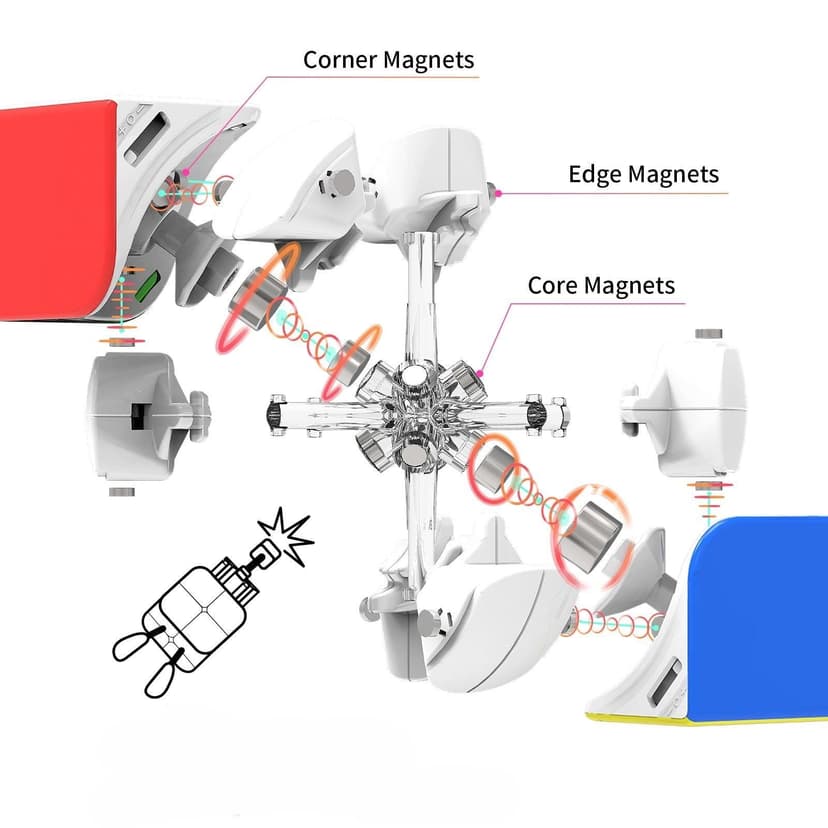
But one of the biggest innovations in speedcubing was something much smaller: magnets.
3. Why Do Speedcubes Have Magnets?
If you have ever used a modern speedcube, you may have noticed that the cube almost seems to 'snap' into position after every turn.
Small magnets are placed inside the pieces of the cube, typically between the edges and corners. When two pieces approach the correct position, the magnets attract each other.

The magnets don't continuously pull the cube around while you're turning it. Instead, they become useful as the pieces approach their intended position.
Turn → pieces move → magnets pull them into alignment → the layer snaps into place
This gives the solver much more control. Without magnets, a fast turn can leave the layer slightly misaligned. With magnets, the cube naturally settles into the correct position.
4. The Cube Needs Both Speed and Control
There is an interesting problem with making a cube faster. If you reduce friction and make the cube turn more freely, it becomes easier to turn quickly—but it can also become harder to control.
Speedcubes therefore aren't simply designed to be as loose and fast as possible. They also need to give the solver control over how the cube feels. That's where tension and spring systems come in.
5. Springs: The Tension System
Traditional speedcubes use springs inside the cube's centers. A screw connected to the core allows the distance between the center and the rest of the mechanism to be adjusted.
If you tighten the screw, the cube becomes tighter. If you loosen it, the cube becomes looser.

A tighter cube generally has less room for the pieces to move away from their normal position. This can make the cube feel more controlled, but it can also reduce its ability to perform corner cuts. A looser cube gives the pieces more freedom to move, which can improve corner cutting and make the cube feel faster—but too much looseness can make the cube unstable.
So, there is a balance:
- Too tight → controlled but restrictive
- Too loose → fast but difficult to control
Finding the right balance is part of customizing a speedcube.
6. Spring Compression
The screw isn't the only thing that can affect how a spring cube feels. The compression of the spring also matters.
Think about squeezing a spring. The more you compress it, the more force it pushes back with. In a speedcube, increasing spring compression increases the resistance inside the mechanism. This can make the cube feel more stable and controlled.

The problem is that manually taking springs out, stretching them, replacing them, and trying to make every spring identical isn't very practical. That's why manufacturers developed a better solution: a dual-adjustment system.
7. Dual-Adjustment Systems
Modern speedcubes often use a dual-adjustment system. As the name suggests, it allows you to adjust two things independently:

- The distance/tension of the cube and
- The compression of the spring
Instead of physically removing and modifying the springs, you can adjust the mechanism directly. This gives speedcubers much more control over the exact feel of their cube.
Some systems use tools to make these adjustments, while others use simpler mechanisms that can be adjusted by hand.
This gives speedcubers much more control over the exact feel of their cube.
8. Adjustable Magnets
Magnets solved one problem, but they created another. Not everyone likes the same magnetic strength. Some people prefer a strong magnetic 'click' after every turn. Others prefer a lighter, smoother feeling.

Manufacturers therefore began developing adjustable magnetic systems. Early systems allowed users to physically replace magnetic components with different strengths. Later designs allowed the position of the magnets to be changed instead.
The basic idea is simple: Closer magnets → stronger magnetic pull. Farther magnets → weaker magnetic pull.
9. What Is a MagLev Speedcube?
One of the more interesting developments in modern speedcubing is MagLev. The name comes from magnetic levitation.

Traditional speedcubes use springs to push the mechanism back toward its normal position. MagLev cubes replace those springs with two magnets that repel each other.
When the mechanism is compressed, the magnets are pushed closer together. Because they repel each other, they push back. In other words, they perform a similar job to a spring—but without the spring physically rubbing against another component.
10. Why Use MagLev?
Less spring friction
A spring is a physical component that can rub and interact with other parts of the mechanism. Repelling magnets don't need to physically touch each other, which can reduce friction within the tension system.
No spring noise
Traditional springs can produce a noticeable springy sound during turning. MagLev removes the traditional spring, so that particular source of noise disappears.
However, MagLev isn't automatically better for everyone. Because the mechanism can become extremely fast and smooth, some cubes may feel too fast or less controllable for certain users. That's why modern cubes often combine MagLev with other technologies designed to bring back control.
11. Core Magnets: More Than Just Edge Magnets
Modern flagship cubes can go even further. Some speedcubes contain magnets connected to the core as well.

Instead of only having magnets between neighboring pieces, these magnets create a magnetic connection between the core and the moving pieces. The advantage is that the magnetic force can act over a greater distance compared with magnets that only interact when two pieces are directly next to each other. This gives the cube another layer of stability and control.
12. Modern Speedcubes Can Have a Lot of Magnets
Once you combine all these systems, a modern flagship cube can contain magnets in several different locations: between corners and edges, inside the core mechanism, in systems that replace traditional springs, and in adjustable magnetic components.
The purpose isn't simply to put as many magnets as possible into a cube. Each magnetic system has a different job:
- Piece magnets → help align the cube
- Core magnets → improve stability and control
- MagLev magnets → replace traditional springs
- Adjustable magnets → let the user customize the feel
13. What About the Outside of the Cube?
The mechanism isn't the only thing that has changed. The surface of the cube has evolved as well.
Older cubes traditionally used stickers for their colors. Modern cubes are often stickerless, meaning the colored plastic itself forms the surface.
Stickerless cubes have an obvious advantage: there are no stickers to peel, scratch, or replace. Modern stickerless cubes can also have different surface finishes.
Matte finish
A matte surface has a less reflective texture and can provide a more controlled grip, particularly for people whose hands get sweaty.

Glossy finish
A glossy surface is smoother and more reflective and can provide a different type of grip.

UV coating
Some premium cubes use a UV-coated surface. It gives the cube a very shiny appearance and changes the texture and grip of the plastic.

The choice is largely personal preference.
14. So, What Actually Makes a Speedcube Fast?
The performance of a speedcube comes from many components working together.
- The core holds everything together;
- Optimized piece design controls how pieces interact;
- Rounded corners allow corner cutting;
- Lubrication and surfaces control friction;
- The tension system controls stability and flexibility;
- Magnets help align pieces;
- Core magnets add stability; and
- MagLev can reduce friction and replace springs.
The goal isn't simply maximum speed. The goal is speed + control + stability.
15. Speedcube vs. a Regular Rubik's Cube
| Feature | Traditional Cube | Modern Speedcube |
|---|---|---|
| Core | Basic | Refined mechanism |
| Piece design | Simple | Optimized for movement |
| Corner cutting | Limited | Much better |
| Magnets | Usually, absent | Common |
| Tension adjustment | Basic | Highly customizable |
| Springs | Traditional | Advanced or replaced by MagLev |
| Surface | Often stickers | Often stickerless |
| Customization | Limited | Extensive |
So when you see a speedcuber turning a cube dozens of times per second, you're not just watching someone with fast fingers. You're watching a puzzle that has been engineered specifically for that purpose.
16. The Future of Speedcubes
As manufacturers reach the limits of traditional mechanical improvements, another category has become increasingly interesting: Smart Cubes.
Smart cubes can connect to a phone or computer and track information about solves, turning the physical puzzle into a connected device.

The future of speedcubing may therefore involve not only better mechanical designs, but also electronics, sensors, apps, and connected puzzles.
The Big Picture
A speedcube may look like a simple six-colored puzzle, but inside it is a surprisingly sophisticated mechanical system.
The basic idea hasn't changed much since the original Rubik's Cube: a core holds the pieces together while the corners and edges rotate around it. What has changed is everything surrounding that basic idea.
Rounded pieces make corner cutting possible. Improved surfaces reduce friction. Springs and tension systems let users customize the cube. Magnets help the pieces align. MagLev replaces traditional springs with repelling magnets, while core magnets add another layer of stability.
And all of these improvements have one goal: to let the solver turn the cube faster without losing control.
That's ultimately what a speedcube is → a Rubik's Cube refined, tuned, and engineered around the art of speedsolving.

RS3M V5 Dual Adjustment 3x3
The MoYu RS3M V5 (Dual Adjustment) is a well-known, affordable magnetic 3x3 speedcube that offers exceptional value at an affordable price. This cube has a vibrant color scheme, magnets added in the factory, and MoYu's traditional dual adjustment method.
This is the best 3x3 under 500 BDT in Bangladesh. This succeeds its older version RS3M 2020 brilliantly.